I think there has ben a lot of confusion over Ahmad Chalabi over the past few months. First, it appeared that the neocons wanted him because he had promised to make Iraq Israel-friendly (which pleased the Richard Perle wing), and becasue he claimed to want democracy (which pleased the Wolfowitz wing) then he was accused of being an Iranian agent (which is neither particularly pro-Israel nor pro-democracy), and so many wonder whose side he is on.
The answer is, in my opinion, obvious.
He is on the side of Ahmad Chalabi.
He will say whatever it takes to get your support, which explains him smooth-talking Israel-supporters (note that I don't say that Israel was necessarily fooled - I'm not entirely certain that the Israeli government always wants the neocons' help) and Iran at the same time.
This would also, by the way, answer Michael Ledeen's question of why the Iranian agents would use a broken code to inform their higher-ups that Chalabi had told them that the code was broken. They recognized him for the duplicitous little **** he was and decided to make certain that he lost face in the eyes of the Americans so he didn't gain any power. This would also be a good way to confirm whether or not the code had actually been broken.
Tuesday, October 05, 2004


Monday, October 04, 2004
The Debate, in a Nutshell
Lawrence Auster explains the gists of each of the major party candidates' messages.
I am irked when people say that Kerry won on style, but Bush won on substance (like Hugh Hewitt). WHAT SUBSTANCE?
I suppose that one could argue that Kerry had more substance than Bush, but that the substance was all bad, but I can't see a single constructive idea that Bush had as far as Iraq goes.
Apparently, his strategy to win in Iraq is "elect me, and the terrorists will give up."
Yikes.
I am irked when people say that Kerry won on style, but Bush won on substance (like Hugh Hewitt). WHAT SUBSTANCE?
I suppose that one could argue that Kerry had more substance than Bush, but that the substance was all bad, but I can't see a single constructive idea that Bush had as far as Iraq goes.
Apparently, his strategy to win in Iraq is "elect me, and the terrorists will give up."
Yikes.
What the Hell Happened to Kenneth Joseph?
Remember Kenneth Joseph, the "human shield" who found out that Iraqis would "commit suicide" if we didn't begin the bombing campaign on Saddam?
Has anyone heard from him other than propagandist Jack Kelly since May of 2003, or anyone since September of 2003?
Plus, look at this story by Carol Lipton.
My question: why isn't anyone holding Jack Kelly's and Joseph Farah's feet to the fire on this one?
And of course, Jack Kelly was also the one who was chortling in late summer/early fall of 2003 that
(A)"The insurgents are a tiny - and dwindling - minority. Most of the country is at peace."
(B)"It is possible the Iraqis were targeted chiefly because they are easier to get at than the Americans," in an article (click on link "(B)") where he was reveling in the fact that the insurgency seemed to be weakening, as it could only hit Iraqi targets, not American ones. Which would be a good point, except that it was a lie - October 2003 had the highest hostile fatalities of any month up to that point since the end of major combat operations in May (35, cf. to the previous high of 28 in July).
Moreover, Kelly never, to my knowledge, corrected himself over the course of the next month (November), when the hostile fatality rate soared more than 2.5 times to 94.
I want to see someone hold Messrs. Kelly and Farah's feet to the fire on this!
Has anyone heard from him other than propagandist Jack Kelly since May of 2003, or anyone since September of 2003?
Plus, look at this story by Carol Lipton.
My question: why isn't anyone holding Jack Kelly's and Joseph Farah's feet to the fire on this one?
And of course, Jack Kelly was also the one who was chortling in late summer/early fall of 2003 that
(A)"The insurgents are a tiny - and dwindling - minority. Most of the country is at peace."
(B)"It is possible the Iraqis were targeted chiefly because they are easier to get at than the Americans," in an article (click on link "(B)") where he was reveling in the fact that the insurgency seemed to be weakening, as it could only hit Iraqi targets, not American ones. Which would be a good point, except that it was a lie - October 2003 had the highest hostile fatalities of any month up to that point since the end of major combat operations in May (35, cf. to the previous high of 28 in July).
Moreover, Kelly never, to my knowledge, corrected himself over the course of the next month (November), when the hostile fatality rate soared more than 2.5 times to 94.
I want to see someone hold Messrs. Kelly and Farah's feet to the fire on this!
Coalition Schmoalition
Mark Levin commits the classic historical error in his column:
Compare the current situation to an older situation, which has been misrepresented by history, and then apply the misrepresentation to the current situation.
Mr. Levin takes the current war coalition, where the US contributes 84.3% of the troops, and compares it to the Korean War, where we contributed 89.8% of the troops (the current coalition also contains twice as many countries (32 cf. to 16).
His conclusion?
"The fact is that President Bush has built a real and impressive coalition in Iraq."
No, Mark, the fact is that we didn't have much of a coalition in Korea. It was a US action under the pretense of the United Nations, not a great coalition.
In contract, we did have a reasonable coalition in the first Gulf War, with over 300,000 troops from other countries cg. to our 540,000 (we were ~ 64.3% of the force), and as I recall, a lot of financial help.
Deroy Murdock attacks those who question our "coalition" by shifting the argument:
"None of America's 33 partners ever had to send so much as a Q-Tip to support Operation Iraqi Freedom. The fact that any nation assigns even one citizen to fight shoulder to shoulder with U.S. GIs should elicit celebration and gratitude,"
Well. let's deal with this; yes, Murdock is right that we should be grateful for even one soldier (which is what many of the countries are sending).
But it is ridiculous to pretend that this is a "real coalition," just as it is preposterous to think that Ross Perot's 1992 campagin was funded by a "coalition" of donors, because some of his supporters sent him a few bucks each.
An inability to get a coalition is not, of course, in and of itself, an argument against the war. If the war was necessary, then we should have done it even without any allies if that had been required.
However, to claim that we have assembled a "real and impressive" coalition is nonsense. We have built an American occupation force with assistance from the British, a little bit of help from the Netherlands, Italy, and Poland, and token support from 27 other countries.
Bush, when faced with this question, will retreat to his defense of naming all of the contries that have sent token forces, and his lap-dogs like Andrew Sullivan will act as if this is a devastating critique of the argument that we don't have much support. I remember a particularly obnoxious talk-radio host (I think it was Dan Pierce) who, when a caller brought this up, played back a tape of Bush listing the countries in the coalition. The fact of the matter is, is that our coalition contains little more than token support from most of the countries.
When Dick Cheney basically said that terrorist atacks would be more likely if Kerry were elected, the otherwise somewhat loopy Adam Yoshida brought up a good point to counter all the huffing and puffing that this was beyond the pale of discourse: "But is it True?"
Bush's response to Kerry's charges that we don't have much of a coalition is to accuse him of discouraging our soldiers. I present the same question to Bush as Adam presented to Kerry supporters: "But is it [i.e. Kerry's criticism] true?"
Compare the current situation to an older situation, which has been misrepresented by history, and then apply the misrepresentation to the current situation.
Mr. Levin takes the current war coalition, where the US contributes 84.3% of the troops, and compares it to the Korean War, where we contributed 89.8% of the troops (the current coalition also contains twice as many countries (32 cf. to 16).
His conclusion?
"The fact is that President Bush has built a real and impressive coalition in Iraq."
No, Mark, the fact is that we didn't have much of a coalition in Korea. It was a US action under the pretense of the United Nations, not a great coalition.
In contract, we did have a reasonable coalition in the first Gulf War, with over 300,000 troops from other countries cg. to our 540,000 (we were ~ 64.3% of the force), and as I recall, a lot of financial help.
Deroy Murdock attacks those who question our "coalition" by shifting the argument:
"None of America's 33 partners ever had to send so much as a Q-Tip to support Operation Iraqi Freedom. The fact that any nation assigns even one citizen to fight shoulder to shoulder with U.S. GIs should elicit celebration and gratitude,"
Well. let's deal with this; yes, Murdock is right that we should be grateful for even one soldier (which is what many of the countries are sending).
But it is ridiculous to pretend that this is a "real coalition," just as it is preposterous to think that Ross Perot's 1992 campagin was funded by a "coalition" of donors, because some of his supporters sent him a few bucks each.
An inability to get a coalition is not, of course, in and of itself, an argument against the war. If the war was necessary, then we should have done it even without any allies if that had been required.
However, to claim that we have assembled a "real and impressive" coalition is nonsense. We have built an American occupation force with assistance from the British, a little bit of help from the Netherlands, Italy, and Poland, and token support from 27 other countries.
Bush, when faced with this question, will retreat to his defense of naming all of the contries that have sent token forces, and his lap-dogs like Andrew Sullivan will act as if this is a devastating critique of the argument that we don't have much support. I remember a particularly obnoxious talk-radio host (I think it was Dan Pierce) who, when a caller brought this up, played back a tape of Bush listing the countries in the coalition. The fact of the matter is, is that our coalition contains little more than token support from most of the countries.
When Dick Cheney basically said that terrorist atacks would be more likely if Kerry were elected, the otherwise somewhat loopy Adam Yoshida brought up a good point to counter all the huffing and puffing that this was beyond the pale of discourse: "But is it True?"
Bush's response to Kerry's charges that we don't have much of a coalition is to accuse him of discouraging our soldiers. I present the same question to Bush as Adam presented to Kerry supporters: "But is it [i.e. Kerry's criticism] true?"
Sunday, October 03, 2004
Casualties Down So Far
According to the Iraq Coalition Casualty Count, as of October 3, there have been only 2 coalition fatalities for them month.
This gives me two predictions:
Either (a) there have been fatalities that haven't been counted up yet (I often notice deaths added to the count two or three days after they occur), or (b) October 2004, like September 2003 and February 2004, is going to show a lull in casualties which will be followed by an uptick, and then in December, we will have another November 2003 and April 2004 - like spike in casualties.
I believe that casualty drops tend to indicate that we are lowering our profile, and they are often associated with an increase in unrest between Iraqis.
Apparently in Samarra we have taken control of a lot of the city. Whether the Iraqi divisions will remain loyal to us remains to be seen.
This gives me two predictions:
Either (a) there have been fatalities that haven't been counted up yet (I often notice deaths added to the count two or three days after they occur), or (b) October 2004, like September 2003 and February 2004, is going to show a lull in casualties which will be followed by an uptick, and then in December, we will have another November 2003 and April 2004 - like spike in casualties.
I believe that casualty drops tend to indicate that we are lowering our profile, and they are often associated with an increase in unrest between Iraqis.
Apparently in Samarra we have taken control of a lot of the city. Whether the Iraqi divisions will remain loyal to us remains to be seen.
Constitution Party and Christian Reconstructionism
I have heard recently that the Constitution Party (whose presidential candidate, Michael Peroutka, I support) is part of the Christian Reconstructionist movement.
According to some things I have read, Reconstructionism is a post-millennialist theology which believes in establishing a theocracy.
I am not certain to what extent the CP is related to Reconstructionism, or to what extent Reconstructionists believe this. As a premillennialist, I don't see worldly power as transforming the earth into Christ's Kingdom.
This is not to say that Reconstructionists and other postmillennialists are not true Christians; there is, in my opinion, too much of an attempt to conflate all incorrect doctrine with what I would call mortal heresy (i.e. doctrine so incorrect that one cannot be a Christian and hold it). But I would be cautious about a worldview that tends toward theocracy.
Of course, many premillennialists are also a little bonkers, as they are overly obsessed with the Rapture and with bringing about the conditions to produce Armageddon. (I say do God's will now and let His plan work out in His Own good time).
In any case, I am still supporting the Constitution Party because (a) nothing on their website suggests that they desire a theocracy at the national level, and currently I am mainly concerned with their national platform (b) if they get to be a political force (like Nader), then whatever problems they have will be made clear, (c) the Constitution Party provides a rallying point for conservatives who are dissatisfied with the GOP; if it turns out to be defective, then said conservatives can split into a more moderate (but still more conservative than the GOP) party later, and (d) as a protest party it can serve as a way to drag the Republicans rightward, whether or not the party becomes a force, and (e) they are not going to win in this election, so if there are any hidden agendas, they won't be able to enact them.
According to some things I have read, Reconstructionism is a post-millennialist theology which believes in establishing a theocracy.
I am not certain to what extent the CP is related to Reconstructionism, or to what extent Reconstructionists believe this. As a premillennialist, I don't see worldly power as transforming the earth into Christ's Kingdom.
This is not to say that Reconstructionists and other postmillennialists are not true Christians; there is, in my opinion, too much of an attempt to conflate all incorrect doctrine with what I would call mortal heresy (i.e. doctrine so incorrect that one cannot be a Christian and hold it). But I would be cautious about a worldview that tends toward theocracy.
Of course, many premillennialists are also a little bonkers, as they are overly obsessed with the Rapture and with bringing about the conditions to produce Armageddon. (I say do God's will now and let His plan work out in His Own good time).
In any case, I am still supporting the Constitution Party because (a) nothing on their website suggests that they desire a theocracy at the national level, and currently I am mainly concerned with their national platform (b) if they get to be a political force (like Nader), then whatever problems they have will be made clear, (c) the Constitution Party provides a rallying point for conservatives who are dissatisfied with the GOP; if it turns out to be defective, then said conservatives can split into a more moderate (but still more conservative than the GOP) party later, and (d) as a protest party it can serve as a way to drag the Republicans rightward, whether or not the party becomes a force, and (e) they are not going to win in this election, so if there are any hidden agendas, they won't be able to enact them.
Communistic Propaganda
Does anyone else see their being something communistic about people always having to refer to the conquest of Iraq as "liberation?" When someone has to use that word every time they talk about anti-warriors (As in "Those who opposed the liberation of Iraq,") I get the same feeling I get when I hear anti-semites from the Arab world refer to Israel as "the Zionist Entity." I just get the feeling that rather than even pretending to honesty, they are operating under the notion that the words they use alter the fundamental realities they are talking about.
Kerry vs. Bush on Iraq
Kerry: The French, Germans, and Russians have 100,000 troops hidden someplace that they are dying to send to Iraq, if only I get elected.
Bush: If I'm elected, the terrorists will give up. Or if they don't, they'll give up after they have elections and they know they've lost because Iraq is now a demnocracy. Or if not then, then they'll give up after the Iraqi Security Forces hit the magic number of 200,000. Or if not that, after the next arbitrary guideline we set.
I'm voting for Michael Peroutka.
No matter who gets elected, expect Kurdish Death Squads.
Bush: If I'm elected, the terrorists will give up. Or if they don't, they'll give up after they have elections and they know they've lost because Iraq is now a demnocracy. Or if not then, then they'll give up after the Iraqi Security Forces hit the magic number of 200,000. Or if not that, after the next arbitrary guideline we set.
I'm voting for Michael Peroutka.
No matter who gets elected, expect Kurdish Death Squads.
Iraq Metrics
One thing that I don't agree with that a lot of people do when talking about Iraq is discuss troop deaths in terms of total American fatalities.
I think that total coalition fatalities from hostile fire is a much better metric, because in terms of measuring the insurgency, a dead Brit is the same as a dead American, and a soldier killed because he cleaned his rifle like
Al Gore is not the same as one killed by an angry Iraqi.
Taken from this measurement, the coalition suffered 18-28 deaths a month from June 2003 to September 2003, 32-39 deaths a month from October 2003 to March 2003 (not including the unusually high number of deaths in November (94) or unusually low number in February (16), and between 44 and 75 deaths a month from May 2003 to September 2003. (April had the unusually high number of 131).
So far, October 2004 has been a slow month, with 2 deaths in ~ 2.5 days. But don't count on it continuing.
My prediction: If we're still in Iraq, expect >100 deaths a month by next summer.
I think that total coalition fatalities from hostile fire is a much better metric, because in terms of measuring the insurgency, a dead Brit is the same as a dead American, and a soldier killed because he cleaned his rifle like
Al Gore is not the same as one killed by an angry Iraqi.
Taken from this measurement, the coalition suffered 18-28 deaths a month from June 2003 to September 2003, 32-39 deaths a month from October 2003 to March 2003 (not including the unusually high number of deaths in November (94) or unusually low number in February (16), and between 44 and 75 deaths a month from May 2003 to September 2003. (April had the unusually high number of 131).
So far, October 2004 has been a slow month, with 2 deaths in ~ 2.5 days. But don't count on it continuing.
My prediction: If we're still in Iraq, expect >100 deaths a month by next summer.
The All-Important Minority Vote
Steve Sailer once again wonders why most reporters assume that the minority vote is so important; a far better strategy for the G.O.P. is to increase its share of the white vote, rather than to keep pandering in order to get a few more percentage points from blacks or Hispanics.
I think that the reason why so many people see the minority vote as so important is BECAUSE in most cases it is so reliably liberal. If blacks vote 90% Democrat, then it would seem that a shift to 20 or 30% G.O.P. is a major win; just like it would be coup if Nader got 10-11% of the vote.
What actually matters in the end is whether there is a significant number of minority votes in the battleground states.
Furthermore, to a Wednesday morning election advisor on November 3, the only way that Bush getting a larger share of the minority vote will matter is if there are battleground states where Kerry won that would have gone for Bush if Bush had a higher share of the minority vote. Getting a higher share wouldn't have mattered if (a) Bush had won anyway, or (b) if Kerry won by a margin more than twice the number of minority votes that Bush could have abstracted (if Bush changes x minority votes from Kerry votes to Bush votes, then in effect the margin narrows by 2x, because each vote won by Bush is also a vote lost to Kerry - the mathematics is more complicated if we include people who decided between voting and not voting or who were convinced to vote/not vote for a third party candidate). I think last election, a higher black vote for Bush would only have mattered in Arizona (Arizona had 185,599 blacks, probably at least 50,000 of whom would be registered voters, and Gore won by only 386 votes) and Florida, (~2.3 million blacks, probably including >750,000 registered voters) where a higher number of blacks voting G.O.P. would not have changed the final outcome but might have prevented the three-week recount crisis.
But psychologically, if Bush had gotten 20% of the black vote, it would have devastated the Democrats; and that's what most people think about.
I think that the reason why so many people see the minority vote as so important is BECAUSE in most cases it is so reliably liberal. If blacks vote 90% Democrat, then it would seem that a shift to 20 or 30% G.O.P. is a major win; just like it would be coup if Nader got 10-11% of the vote.
What actually matters in the end is whether there is a significant number of minority votes in the battleground states.
Furthermore, to a Wednesday morning election advisor on November 3, the only way that Bush getting a larger share of the minority vote will matter is if there are battleground states where Kerry won that would have gone for Bush if Bush had a higher share of the minority vote. Getting a higher share wouldn't have mattered if (a) Bush had won anyway, or (b) if Kerry won by a margin more than twice the number of minority votes that Bush could have abstracted (if Bush changes x minority votes from Kerry votes to Bush votes, then in effect the margin narrows by 2x, because each vote won by Bush is also a vote lost to Kerry - the mathematics is more complicated if we include people who decided between voting and not voting or who were convinced to vote/not vote for a third party candidate). I think last election, a higher black vote for Bush would only have mattered in Arizona (Arizona had 185,599 blacks, probably at least 50,000 of whom would be registered voters, and Gore won by only 386 votes) and Florida, (~2.3 million blacks, probably including >750,000 registered voters) where a higher number of blacks voting G.O.P. would not have changed the final outcome but might have prevented the three-week recount crisis.
But psychologically, if Bush had gotten 20% of the black vote, it would have devastated the Democrats; and that's what most people think about.
Great Quotes from the Election
"It was a very Republican sex scandal: the two protagonists were married and there was no sex." Joe Guzzardi, on the Jack Ryan scandal.
"Bush resolved never to allow himself to be outdumbed again. And the Democrats haven't outsmarted him since." Steve Sailer, after discussing George W. Bush's failed Congressional run in 1978, where Bush was defeated by a man who made fun of his fancy Yale degree. (Quote is from American Conservative Article, link opens to excerpt from his weblog).
I will try to add to this.
"Bush resolved never to allow himself to be outdumbed again. And the Democrats haven't outsmarted him since." Steve Sailer, after discussing George W. Bush's failed Congressional run in 1978, where Bush was defeated by a man who made fun of his fancy Yale degree. (Quote is from American Conservative Article, link opens to excerpt from his weblog).
I will try to add to this.
Saturday, October 02, 2004
Samarra
Apparently we are taking or re-taking Samarra using Iraqi Security Forces.
Do Iraqi Security forces = Kurdish Death Squads? Inquiring minds want to know.
Do Iraqi Security forces = Kurdish Death Squads? Inquiring minds want to know.
Attractive Women
I have weird taste in women, yes.
Sexiest vampiress: Urs (played by Kristin Lehman). Another pic
Sexiest actress: Lysette Anthony
Sexiest Marvel Character: Nocturne, aka T.J. Wagner, daughter of Nightcrawler (Kurt Wagner) and the Scarlet Witch (Wanda Maximoff).
Sexiest vampiress: Urs (played by Kristin Lehman). Another pic


Sexiest actress: Lysette Anthony

Sexiest Marvel Character: Nocturne, aka T.J. Wagner, daughter of Nightcrawler (Kurt Wagner) and the Scarlet Witch (Wanda Maximoff).

Friday, October 01, 2004
Gender-Neutral Statutory Rape
Should Mary-Kay Letourneau be considered a (statutory) rapist and be treated the same as a male (statutory) offender?
Yes, I argue, for the following reason:
Generally, the reason for age-of-consent laws is to protect an older person from taking advantage of a minor's inexperience and lack of capacity; for example, a fourteen-year-old girl may not be mature enough to deal with the possibility of pregnancy, and therefore an older man should not be allowed totake advantage of that.
The assumption that results in non-gender-neutral statutory rape laws (or alternately enforcement) is based on the assumption that because boyus don't get pregnant, sex is not as much of a responsibility with them.
However, in any western culture it is assumed that men will help to care for their children, even if indirectly through financial support.
A teenage or pre-teen boy who has sex is risking a possible obligation to any child produced in the union. This is particularly true because courts have ordered child support payments to be made for children who were conceived when the male (but not the female) was below the age of consent, and because after conception occurs, the father has no rights toward the child at least until it is born. A boy who gets a woman pregnant can have his life ruined, even if he doesn't carry the baby.
Moreover, there are also physical risks such as venereal disease.
Given this, I think that a woman who has sex with an underage boy is subjecting him to risks that he is not yet capable of dealing with, and therefore is just as guilty as a male offender.
This might be different in cultures where males are not expected to be involved in their children's upbringing.
Yes, I argue, for the following reason:
Generally, the reason for age-of-consent laws is to protect an older person from taking advantage of a minor's inexperience and lack of capacity; for example, a fourteen-year-old girl may not be mature enough to deal with the possibility of pregnancy, and therefore an older man should not be allowed totake advantage of that.
The assumption that results in non-gender-neutral statutory rape laws (or alternately enforcement) is based on the assumption that because boyus don't get pregnant, sex is not as much of a responsibility with them.
However, in any western culture it is assumed that men will help to care for their children, even if indirectly through financial support.
A teenage or pre-teen boy who has sex is risking a possible obligation to any child produced in the union. This is particularly true because courts have ordered child support payments to be made for children who were conceived when the male (but not the female) was below the age of consent, and because after conception occurs, the father has no rights toward the child at least until it is born. A boy who gets a woman pregnant can have his life ruined, even if he doesn't carry the baby.
Moreover, there are also physical risks such as venereal disease.
Given this, I think that a woman who has sex with an underage boy is subjecting him to risks that he is not yet capable of dealing with, and therefore is just as guilty as a male offender.
This might be different in cultures where males are not expected to be involved in their children's upbringing.
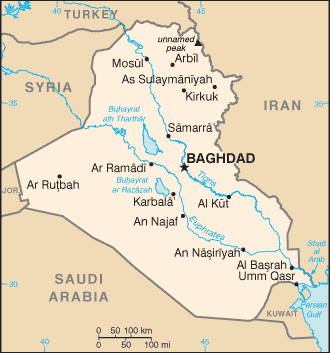
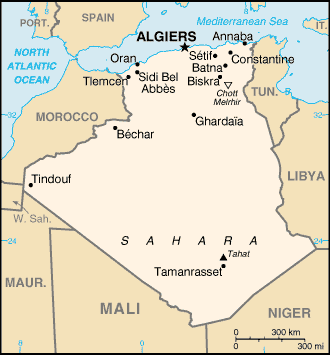
Algeria and Iraq
Joel Mowbray is a Moron
In an article on FrontPageMag, Joel Mowbray makes the statement:
"The Democrat hammered home that he would secure former Soviet nukes in 4 years instead of 13—this is the issue gripping Americans, after all"
Yes, Joel, what a stupid idea that Americans might be concerned about loose nukes in the former Soviet Union. Most Americans are actually concerned with why your buddy Ahmad Chalabi isn't the president of Iraq by now.
"The Democrat hammered home that he would secure former Soviet nukes in 4 years instead of 13—this is the issue gripping Americans, after all"
Yes, Joel, what a stupid idea that Americans might be concerned about loose nukes in the former Soviet Union. Most Americans are actually concerned with why your buddy Ahmad Chalabi isn't the president of Iraq by now.
Nucular Weapons
Question for the politically minded:
If we don't crack down on Nucular weapons, will Jenjiss Khan acquire them?
If we don't crack down on Nucular weapons, will Jenjiss Khan acquire them?
Subscribe to:
Posts (Atom)